


03/09/2026
Northern Ireland Peace Index Finds Violence Down As Deeper Foundations Stall
Queen's researchers, working with IEP and funded by the Economic and Social Research Council (ESRC), have published the first Northern Ireland Peace Index (NIPI), tracking both Negative Peace (the absence of violence and fear of violence) and Positive Peace (the attitudes, institutions and structures that sustain peaceful societies) across the eleven Local Government Districts from 2019 to 2025.
The report finds substantial gains in safety and security since 2019, but far slower advancement in the broader social, economic and governance foundations needed to secure peace over the long term.
Across the period, Negative Peace improved by 10.7%, with the steepest improvements in the last two years. Homicide fell by 47.9% and paramilitary activity declined by 44.7%. Hate crime was the only Negative Peace indicator to worsen, rising by 21.5%.
Positive Peace increased by just 0.9% over the same timeframe, signalling that deeper structural change is lagging. Notably, confidence in the justice system fell by 24%, planning decision efficiency dropped by 41%, and research and development spending declined by 34%.
Some Positive Peace indicators did strengthen: gigabit-capable broadband coverage rose by 57%, parity in public appointments improved by 33%, and the gender pay gap narrowed by 13%.
Local patterns varied. Belfast recorded the strongest overall Positive Peace position but also the highest concentration of recorded violence. Derry and Strabane had the weakest Positive Peace position, yet showed some of the largest improvements in violence-related measures since 2019.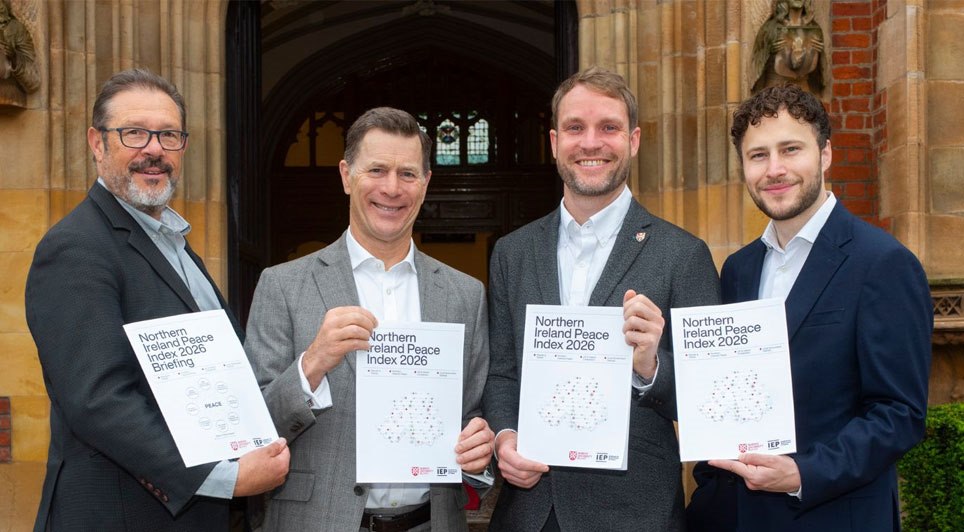 Principal Investigator, Dr Andrew Thomson from Queen's said: "The findings in this report give us both reasons for optimism and reasons to carefully assess what might come next. Northern Ireland is much less violent than before, but the foundations for peace have not consolidated at the same rate. The challenge now is to continue to strengthen the conditions that sustain peace; building trust in institutions, investing in communities and the economy, and addressing the structural inequalities and weaknesses that can leave peace vulnerable."
The research team points to priorities for sustaining peace, including boosting private-sector investment to drive innovation and high-value jobs, accelerating house-building, and rebuilding trust between government and citizens.
Co-Investigator Professor Dominic Bryan from Queen's commented: "As the Institute for Economics and Peace has shown in developing peace indexes around the world, policies of positive peace are something that all societies need to work on.
"This report aims to understand peace in a much more ambitious way. The idea of a 'positive peace' challenges us to look at the conditions in which people thrive. It allows us to identify strengths and weaknesses in a process that has been underway for over three decades and to make some comparisons with other parts of the world.
"I hope the report provides a model that can be used by organisations working on peace to strategically develop their work as well as open-up debates over peace building and 'good relations' policies at regional and LGD levels."
Brett Savill, Chief Operating Officer from the Institute for Economics and Peace (IEP) remarked: "IEP is proud to be working with Queen's University on this important project. Positive Peace is a transformational concept whose time has come in Northern Ireland."
The NIPI offers an evidence-based, forward-looking framework to assess where peace is consolidating and where progress is stalling. A practitioner toolkit and the full report are available online to support policymakers and organisations working on peacebuilding across Northern Ireland.
The report finds substantial gains in safety and security since 2019, but far slower advancement in the broader social, economic and governance foundations needed to secure peace over the long term.
Across the period, Negative Peace improved by 10.7%, with the steepest improvements in the last two years. Homicide fell by 47.9% and paramilitary activity declined by 44.7%. Hate crime was the only Negative Peace indicator to worsen, rising by 21.5%.
Positive Peace increased by just 0.9% over the same timeframe, signalling that deeper structural change is lagging. Notably, confidence in the justice system fell by 24%, planning decision efficiency dropped by 41%, and research and development spending declined by 34%.
Some Positive Peace indicators did strengthen: gigabit-capable broadband coverage rose by 57%, parity in public appointments improved by 33%, and the gender pay gap narrowed by 13%.
Local patterns varied. Belfast recorded the strongest overall Positive Peace position but also the highest concentration of recorded violence. Derry and Strabane had the weakest Positive Peace position, yet showed some of the largest improvements in violence-related measures since 2019.
The research team points to priorities for sustaining peace, including boosting private-sector investment to drive innovation and high-value jobs, accelerating house-building, and rebuilding trust between government and citizens.
Co-Investigator Professor Dominic Bryan from Queen's commented: "As the Institute for Economics and Peace has shown in developing peace indexes around the world, policies of positive peace are something that all societies need to work on.
"This report aims to understand peace in a much more ambitious way. The idea of a 'positive peace' challenges us to look at the conditions in which people thrive. It allows us to identify strengths and weaknesses in a process that has been underway for over three decades and to make some comparisons with other parts of the world.
"I hope the report provides a model that can be used by organisations working on peace to strategically develop their work as well as open-up debates over peace building and 'good relations' policies at regional and LGD levels."
Brett Savill, Chief Operating Officer from the Institute for Economics and Peace (IEP) remarked: "IEP is proud to be working with Queen's University on this important project. Positive Peace is a transformational concept whose time has come in Northern Ireland."
The NIPI offers an evidence-based, forward-looking framework to assess where peace is consolidating and where progress is stalling. A practitioner toolkit and the full report are available online to support policymakers and organisations working on peacebuilding across Northern Ireland.
Related Northern Ireland News Stories
Click here for the latest headlines.
12 January 2009
Peace People Return To Belfast
A veteran of many 'peace' rallies in the 1970s - Mairead Corrigan Maguire - one of the original anti-NI Troubles 'Peace People', has addressed a large Belfast crowd to condemn the actions of the Israeli government in Gaza. She was speaking at the weekend when the City Hall demonstration was held against the Israeli attack on the Gaza area.
Peace People Return To Belfast
A veteran of many 'peace' rallies in the 1970s - Mairead Corrigan Maguire - one of the original anti-NI Troubles 'Peace People', has addressed a large Belfast crowd to condemn the actions of the Israeli government in Gaza. She was speaking at the weekend when the City Hall demonstration was held against the Israeli attack on the Gaza area.
31 January 2002
John Hume honoured with Ghandi Peace Prize
Former leader of the SDLP and Nobel Laureate John Hume will be honoured in India with the Ghandi Peace Prize.
John Hume honoured with Ghandi Peace Prize
Former leader of the SDLP and Nobel Laureate John Hume will be honoured in India with the Ghandi Peace Prize.
12 March 2004
Urgency creeps into Northern Ireland peace process
A renewed sense of urgency evident on Thursday night as Taoiseach Bertie Ahern and Prime Minister Tony Blair met in Dublin to discuss the Northern Ireland peace process. The two premiers pledged to take personal charge of a bid to break the deadlock following the return of the politicians from St Patrick's Day celebrations in Washington next week.
Urgency creeps into Northern Ireland peace process
A renewed sense of urgency evident on Thursday night as Taoiseach Bertie Ahern and Prime Minister Tony Blair met in Dublin to discuss the Northern Ireland peace process. The two premiers pledged to take personal charge of a bid to break the deadlock following the return of the politicians from St Patrick's Day celebrations in Washington next week.
27 March 2003
Nobel peace prize winner arrested in Washington
Northern Ireland peace prize winner Mairead Corrigan-Maguire has been arrested during an anti-war protest in Washington. Mrs Maguire, fellow Nobel laureate Jody Williams and two American bishops, were among 60 people demonstrating outside the White House last night.
Nobel peace prize winner arrested in Washington
Northern Ireland peace prize winner Mairead Corrigan-Maguire has been arrested during an anti-war protest in Washington. Mrs Maguire, fellow Nobel laureate Jody Williams and two American bishops, were among 60 people demonstrating outside the White House last night.
18 July 2001
BUSH CALLS FOR DECOMMISSIONING
US President George W Bush has called on the IRA and loyalist paramilitary groups to decommission their weapons in his most demonstrative statement regarding the Northern Ireland peace process to date. Mr Bush’s first public comments are widely regarded to increase pressure on the IRA and loyalists to break the deadlock in the political process.
BUSH CALLS FOR DECOMMISSIONING
US President George W Bush has called on the IRA and loyalist paramilitary groups to decommission their weapons in his most demonstrative statement regarding the Northern Ireland peace process to date. Mr Bush’s first public comments are widely regarded to increase pressure on the IRA and loyalists to break the deadlock in the political process.
-




 Northern Ireland WeatherThis Evening and Tonight:Storm Boelo will bring strengthening westerly winds with severe gales developing through the evening and overnight. The strongest winds will be along the North Coast. Frequent showers will be heavy at times. Minimum temperature 7 °C.