


05/10/2026
Superintendent's House At Silent Valley Restored To Safeguard Heritage
One of Silent Valley's most distinctive historic buildings has reopened following a comprehensive conservation and restoration effort by NI Water.
The Superintendent's House, which has stood at the entrance to the Silent Valley Estate for more than 120 years, has been carefully refurbished under NI Water's Historic Estate Project to ensure it remains functional and relevant for future generations.
Originally constructed to accommodate the Water Commissioner's Superintendent and his family during the building of the Silent Valley Reservoir, the property has been sympathetically adapted to support those who care for the Mournes, including staff and volunteers from Mourne Heritage Trust (MHT).
The programme, delivered by GEDA Construction and managed by Tetra Tech alongside Dickson Fitzgerald Architects, reinstates many original architectural details while discreetly integrating modern amenities. The team worked in close collaboration with the Department for Communities' Historic Environment Division to conserve the building's character and significance.
Michael Donnelly, NI Water Senior Project Manager, said: "The completion of the Superintendent's House marks another important milestone in NI Water's Historic Estate Project - a rolling programme of work to survey, protect and care for listed assets within NI Water's ownership. Our aim has always been to protect the unique heritage of this remarkable building while ensuring it remains fit for purpose for generations to come.
"Throughout the restoration our project partners – GEDA, Tetra Tech and Dickson Fitzgerald Architects – have worked closely with the Department for Communities' Historic Environment Division to retain as much of the building's original character as possible. Traditional conservation techniques have been combined with carefully considered modern improvements, allowing us to preserve the building's history while creating a practical workspace for those who continue to look after this special landscape."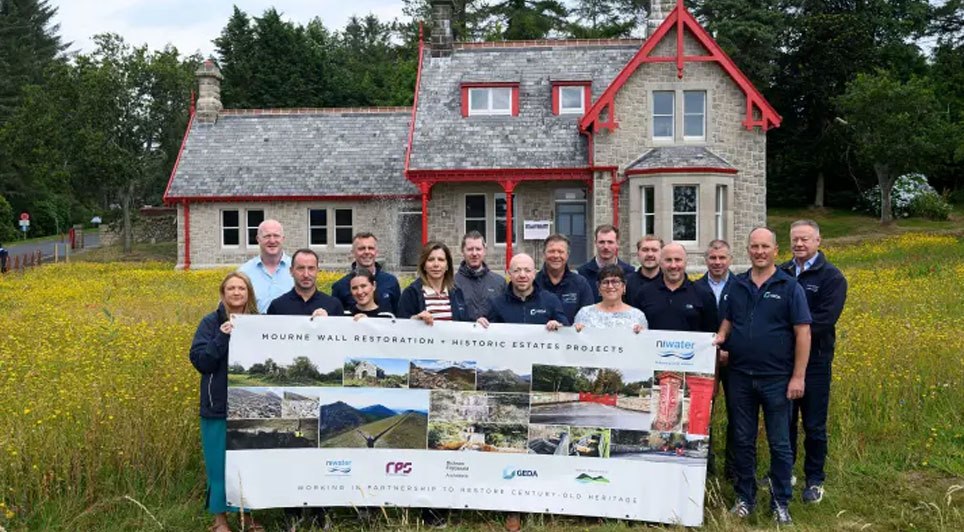 Work included careful repair and enhancement of original sliding sash windows, conservation of decorative timber elements, rebuilding of historic chimneys using traditional methods, and the reuse of reclaimed timber for new flooring. Heritage-appropriate materials were applied throughout, while new archive, meeting and welfare spaces have been created to support conservation activity across the Mournes without compromising the house's historic fabric.
Local skills were central to the project, with specialist subcontractors, craftspeople and suppliers providing lime plastering, bespoke joinery, furniture restoration, heritage glazing and stone conservation. Sourcing materials and services locally helped sustain the regional economy and maintain traditional craftsmanship.
Michael continued: "Projects like this rely on specialist skills and we're extremely proud that so much of that expertise could be found here in the Mournes area as well as other parts of Northern Ireland. From local joiners and stonemasons to flooring specialists and conservation contractors, every organisation involved has played an important role in bringing this historic building back to life.
"The Superintendent's House has witnessed more than a century of the Mourne Water Supply Scheme, and thanks to this restoration it will continue to play an important role in supporting the people who work every day to protect and care for the Mournes."
The Superintendent's House is one of 44 listed assets under NI Water's stewardship, alongside landmarks such as the Mourne Wall, Silent Valley Red Gates and Dunnywater Aqueduct. The restoration underscores NI Water's commitment to protecting these heritage structures so they remain valued community assets.
The project has been shortlisted for the Restoration Award at the 2026 CEF Construction Excellence Awards. Among the notable details is the boardroom's reclaimed herringbone timber floor, salvaged from St. Mary's Primary School in Glasdrumman, which closed in 2018. The flooring was restored by Ballymartin flooring specialist, David Wilson, whose father-in-law laid the original in the 1950s.
All but one of the original sliding sash windows were repaired and fitted with slimline double glazing to improve energy performance without altering their appearance. Traditional timber laths and plaster were retained where possible, with repairs using lime plaster and breathable finishes to protect the granite walls. The boardroom's mahogany table and chairs were also meticulously restored, with original mechanisms returned to working order, while discreet modern technology enables meetings and presentations. Additional upgrades include WiFi, solar panels, underfloor heating and a ground source heat pump.
The Superintendent's House, which has stood at the entrance to the Silent Valley Estate for more than 120 years, has been carefully refurbished under NI Water's Historic Estate Project to ensure it remains functional and relevant for future generations.
Originally constructed to accommodate the Water Commissioner's Superintendent and his family during the building of the Silent Valley Reservoir, the property has been sympathetically adapted to support those who care for the Mournes, including staff and volunteers from Mourne Heritage Trust (MHT).
The programme, delivered by GEDA Construction and managed by Tetra Tech alongside Dickson Fitzgerald Architects, reinstates many original architectural details while discreetly integrating modern amenities. The team worked in close collaboration with the Department for Communities' Historic Environment Division to conserve the building's character and significance.
Michael Donnelly, NI Water Senior Project Manager, said: "The completion of the Superintendent's House marks another important milestone in NI Water's Historic Estate Project - a rolling programme of work to survey, protect and care for listed assets within NI Water's ownership. Our aim has always been to protect the unique heritage of this remarkable building while ensuring it remains fit for purpose for generations to come.
"Throughout the restoration our project partners – GEDA, Tetra Tech and Dickson Fitzgerald Architects – have worked closely with the Department for Communities' Historic Environment Division to retain as much of the building's original character as possible. Traditional conservation techniques have been combined with carefully considered modern improvements, allowing us to preserve the building's history while creating a practical workspace for those who continue to look after this special landscape."
Local skills were central to the project, with specialist subcontractors, craftspeople and suppliers providing lime plastering, bespoke joinery, furniture restoration, heritage glazing and stone conservation. Sourcing materials and services locally helped sustain the regional economy and maintain traditional craftsmanship.
Michael continued: "Projects like this rely on specialist skills and we're extremely proud that so much of that expertise could be found here in the Mournes area as well as other parts of Northern Ireland. From local joiners and stonemasons to flooring specialists and conservation contractors, every organisation involved has played an important role in bringing this historic building back to life.
"The Superintendent's House has witnessed more than a century of the Mourne Water Supply Scheme, and thanks to this restoration it will continue to play an important role in supporting the people who work every day to protect and care for the Mournes."
The Superintendent's House is one of 44 listed assets under NI Water's stewardship, alongside landmarks such as the Mourne Wall, Silent Valley Red Gates and Dunnywater Aqueduct. The restoration underscores NI Water's commitment to protecting these heritage structures so they remain valued community assets.
The project has been shortlisted for the Restoration Award at the 2026 CEF Construction Excellence Awards. Among the notable details is the boardroom's reclaimed herringbone timber floor, salvaged from St. Mary's Primary School in Glasdrumman, which closed in 2018. The flooring was restored by Ballymartin flooring specialist, David Wilson, whose father-in-law laid the original in the 1950s.
All but one of the original sliding sash windows were repaired and fitted with slimline double glazing to improve energy performance without altering their appearance. Traditional timber laths and plaster were retained where possible, with repairs using lime plaster and breathable finishes to protect the granite walls. The boardroom's mahogany table and chairs were also meticulously restored, with original mechanisms returned to working order, while discreet modern technology enables meetings and presentations. Additional upgrades include WiFi, solar panels, underfloor heating and a ground source heat pump.
Related Northern Ireland News Stories
Click here for the latest headlines.
03 October 2023
Report Highlights Quality Of NI Drinking Water
Northern Ireland's drinking water remains at a 'high standard', according to the new Drinking Water Inspectorate (DWI) report for 2022.
Report Highlights Quality Of NI Drinking Water
Northern Ireland's drinking water remains at a 'high standard', according to the new Drinking Water Inspectorate (DWI) report for 2022.
23 September 2022
NI Drinking Water Quality 'Remains High'
The quality of drinking water across NI remains highs, according to the latest report from the Drinking Water Inspectorate (DWI).
NI Drinking Water Quality 'Remains High'
The quality of drinking water across NI remains highs, according to the latest report from the Drinking Water Inspectorate (DWI).
23 October 2026
NI Water Urges Households To Mark Water Night And Save Water
NI Water is calling on people to take part in Water Night on Thursday 22 October, setting aside one evening to reflect on the value of water and the simple, everyday actions that help protect this vital resource.
NI Water Urges Households To Mark Water Night And Save Water
NI Water is calling on people to take part in Water Night on Thursday 22 October, setting aside one evening to reflect on the value of water and the simple, everyday actions that help protect this vital resource.
18 September 2024
Water Is 'Safe To Drink And Use As Normal' – NI Water
NI Water has reassured households that their water is "safe to drink and use as normal". The public utility company has said that their number one priority is the quality and safety of drinking water.
Water Is 'Safe To Drink And Use As Normal' – NI Water
NI Water has reassured households that their water is "safe to drink and use as normal". The public utility company has said that their number one priority is the quality and safety of drinking water.
15 September 2023
NI Water 'Safe To Drink And Use As Normal'
Water supplied from all NI Water's Water Treatment Works, including water abstracted from Lough Neagh, is safe to drink and use as normal. The utility provider has responded to calls from the DUP to clarify the safety of NI's drinking water.
NI Water 'Safe To Drink And Use As Normal'
Water supplied from all NI Water's Water Treatment Works, including water abstracted from Lough Neagh, is safe to drink and use as normal. The utility provider has responded to calls from the DUP to clarify the safety of NI's drinking water.
-




 Northern Ireland WeatherToday:Cloudy with rain in the east through the morning before turning dry in the afternoon. Further west will be mostly dry with some brighter spells. Light winds. Maximum temperature 8 °C.Tonight:It will be dry through the evening and overnight with cloud breaking up to give some clear spells. Becoming breezy around exposed coasts. Minimum temperature 2 °C.